AudioMagic RX Noise Elimination
ICOM uses a Silicon Labs CP2102 chip (a USB-TO-UART BRIDGE) for control via the CI-V protocol and a Texas Instruments PCM2901 Audio Codec chip for digital audio transmission. If AudioMagic is already configured, there is nothing special left to do for the RX part called NoiseMagic.
There are exactly 3 things that can be adjusted:
- Active / Passive switch to turn NoiseMagic on or off
- Wet / Dry slider that controls the mix ratio between the original signal and the cleaned signal
- Volume slider, which affects the output devices.
The most important control is the Wet/Dry slider. When getting to know NoiseMagic, you might be surprised that there is initially complete silence where there used to be noise. Therefore, I recommend setting it to 50% at the beginning to get your brain used to the new circumstances (This is not a joke!). 50%-65% is also recommended if a signal is borderline, i.e., NoiseMagic cannot decide whether it is noise (which would mean silence) or a human voice.
Otherwise, NoiseMagic just does its "job". To document QSOs, a recorder is built in, which records some data about the QSO alongside the RX AND TX signals and makes it available as a separate file, in addition to the audio. Downloadable via the browser. The QSOs can also be labeled. For QSOs where only RX is recorded, a comment can be recorded via microphone. This means the microphone is "open" even during RX (TX only takes place during PTT). Exception: RX and TX via computer, in which case the microphone is only open during PTT.
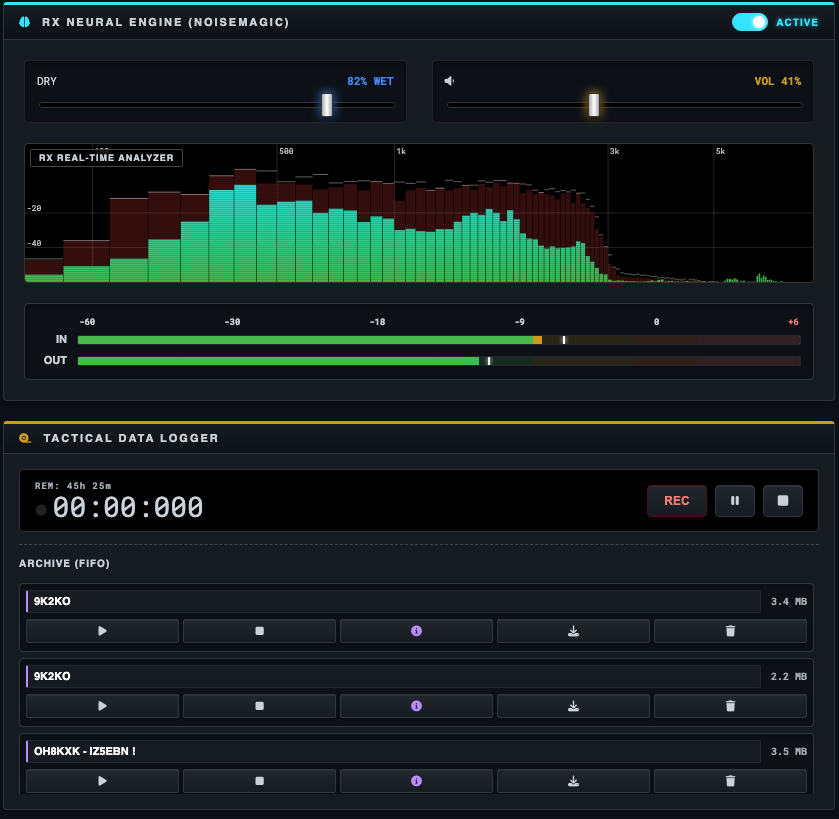
NoiseMagic in Action.
The shadow represents the noise level during speech, while the foreground is the filtered speech. The small green "bumps" on the right are added signals that increase intelligibility; this is done by the neural network.
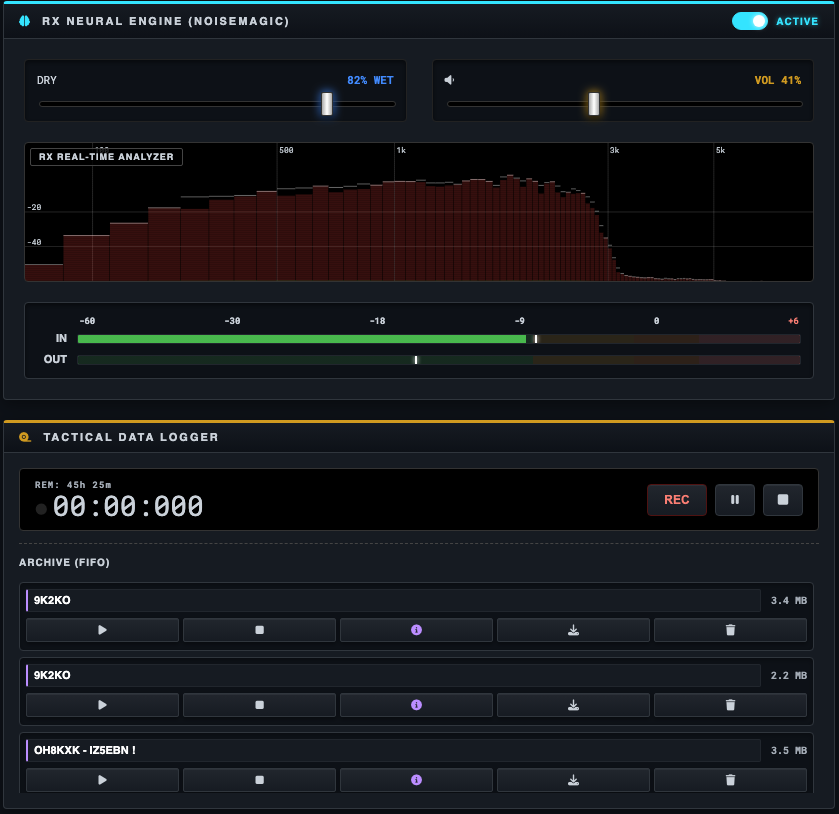
No Voice, no Noise - "0" !!
What makes NoiseMagic so special? If I were to say... very simple to explain... then that would be a flat-out lie. NoiseMagic is based on a neural network algorithm and has to be trained. This means approx. 5000 noise snippets were "learned" by the neural network along with 20,000 studio voices. However, the latter first had to be trimmed to sound like "dirty SSB" and then downsampled from 48kHz to 16kHz so that they match the TRX output and can be processed. After several months of work were completed, the result was so phenomenal that NoiseMagic started inventing voices (hallucinating) when there was only noise. It sounded like distant mumbling. This was then eradicated using a Voice Activity Detector, which is also a neural network working in reverse.
What makes NoiseMagic so captivating. No knobs to turn, no filters to constantly fine-tune. On / Off, Wet / Dry - that's it. Ok, every now and then you might get a scare if you forgot you were wearing headphones and a voice suddenly speaks out of "nowhere"!